The published test, and what it is actually measuring
The 25,000-cycle door test in KCMA A161.1-2022 is a hardware test wearing a cabinet's clothes. Almost everything it checks afterwards is a hinge or a fixing, which is a fair reflection of what actually fails in a kitchen.
Section 6.2 cycles a door 25,000 times at 20 ± 2 cycles per minute, where one cycle is a full open and close. Afterwards, five conditions have to be met: the door is still functional and the door-holding or closure device is still adequate to hold it in the closed position; the door shape is unchanged from the pre-test record; the sag at the measured point is no more than 1.6 millimetres, 0.065 inch; the hinges show no visible sign of damage or loss of function; and the hardware attachment has not become loose, at either the cabinet-to-hinge or the hinge-to-door connection.
At ten openings a day, 25,000 cycles is roughly seven years. At thirty openings a day, which is realistic for the cabinet beside the dishwasher, it is just over two. That is a useful way to read the number: it is not a lifetime, it is a floor.
There is a second, static test that matters more than people realise. Section 6.1 hangs 29.5 kilograms, 65 pounds, on the door, 14.75 kilograms on each side, at a 254 millimetre, 10 inch offset, through ten cycles from 90 degrees open, then leaves it weighted for ten minutes. The door shape must be unchanged afterwards. That is the child-hanging-off-the-door test, and it is the one that exposes a door hung on too few hinges.
| Section | What is applied | What has to be true afterwards |
|---|---|---|
| 6.1 Door racking and hinge loading | 65 lb on the door at a 10 in. offset, ten cycles from 90 degrees, held weighted for ten minutes | The door shape is unchanged |
| 6.2 Door, door-holding and hinge operation | 25,000 cycles at 20 ± 2 cycles per minute | Door functional, closure device still holds, sag no more than 0.065 in., hinges undamaged, hardware attachment not loosened |
| 7.1 Drawer operation | Loaded at 15 lb/ft², 25,000 cycles at 20 cycles per minute, opening two-thirds of the extension each time | Still operable while loaded, no failure in the drawer assembly or operating system, drawer bottom not deflected into the slide path |
| 7.2 Drawer-closing impact | Closing impact of the kind expected in household use, with the drawer clamped in a test stand | The drawer-front assembly survives |
| 5.2 Wall cabinet mounting | 600 lb up to 36 in. wide, 800 lb at 36 to 60 in., 20 lb per inch above | No visible failure in the cabinet or in the mounting system |
| 9.6 Rust resistance | A panel scratched to bare metal, 288 hours at 100 percent relative humidity and 37 to 39 °C | No blisters, rust creep from the scratch no more than 0.0625 in. |
Source: KCMA A161.1-2022, Kitchen Cabinet Manufacturers Association. Section 9.6 is written for metal cabinets; it is quoted here as the clearest published corrosion benchmark available for coastal hardware.
Hinges: count, type and the sag limit
Two hinges up to roughly 40 inches of door height, three above that, and more for heavy doors regardless of height. The governing number is the 0.065 inch sag limit, not the cycle count.
Sag is the practical failure. A door hung on too few hinges does not fall off; it droops at the outer top corner, and the reveal that was even at handover becomes a visible wedge. Because the published limit is 0.065 inch, which is close to a sixteenth of an inch, it is the kind of deviation the eye picks up immediately on a run of doors even when it cannot name what is wrong.
Hinge type follows the cabinet rather than the taste. Concealed European hinges, the cup-and-plate type, are the default on both framed and frameless cabinetry and are the only type with meaningful three-way adjustment, which matters on an install into an out-of-true opening. Butt hinges and exposed hinges are a style decision with a practical cost: they have little or no adjustment, so the carcass has to be right.
Opening angle is the specification detail most often missed. A standard hinge opens to about 110 degrees, which is fine for an ordinary door and not fine for a door that has to clear a drawer below it or a corner cabinet that has to open past an adjacent face. Where a pull-out has to come out past an open door, the hinge angle is a functional requirement rather than an upgrade.
Drawer slides, ratings and the undermount question
Specify slides by load rating, as a number on the quote, because the published test load is a household average rather than a kitchen reality.
The test loads a drawer at 718 Pascals, 15 pounds per square foot, and runs it through 25,000 cycles at 20 cycles a minute, each cycle opening the drawer two-thirds of its extension length. Afterwards the drawer must remain operable while still loaded, nothing in the assembly may have failed, and the drawer bottom must not have deflected to a position that interferes with the slide.
Fifteen pounds per square foot on a 30 by 21 inch drawer is about 65 pounds, which is a reasonable drawer of crockery and a long way below a drawer of cast iron or a loaded pantry pull-out. That is why the rating matters: the test establishes a baseline, and the specification has to exceed it wherever the contents do.
| Type | Characteristics | Best use |
|---|---|---|
| Side-mount, epoxy-coated roller | Cheapest, partial extension, visible at the drawer side, limited rating | Low-cost cabinetry and light contents. The type most often found failing in 1980s Newport Beach kitchens. |
| Side-mount, ball bearing, full extension | Good ratings, full access to the drawer, visible runners at the sides | Garage, workshop, laundry and anywhere the appearance of the runner is irrelevant |
| Undermount, full extension, soft-close | Invisible in use, excellent feel, requires a specific drawer box construction with a notched base | Kitchens and any cabinetry where the drawer interior is on show |
| Heavy-duty pantry and larder runners | High ratings, designed for a full-height loaded unit | Pull-out pantries and tall larder units, where the load is far above the test baseline |
One compatibility note that saves a wasted order. Side-mount to undermount is not a straight swap, because undermount slides require a drawer box of a specific width with a notched or rebated base to engage the runner. Changing slide type usually means changing drawer boxes, which is a bigger job than it sounds and is often better done as part of a refacing project than on its own.
Hardware in a city that is more than half water
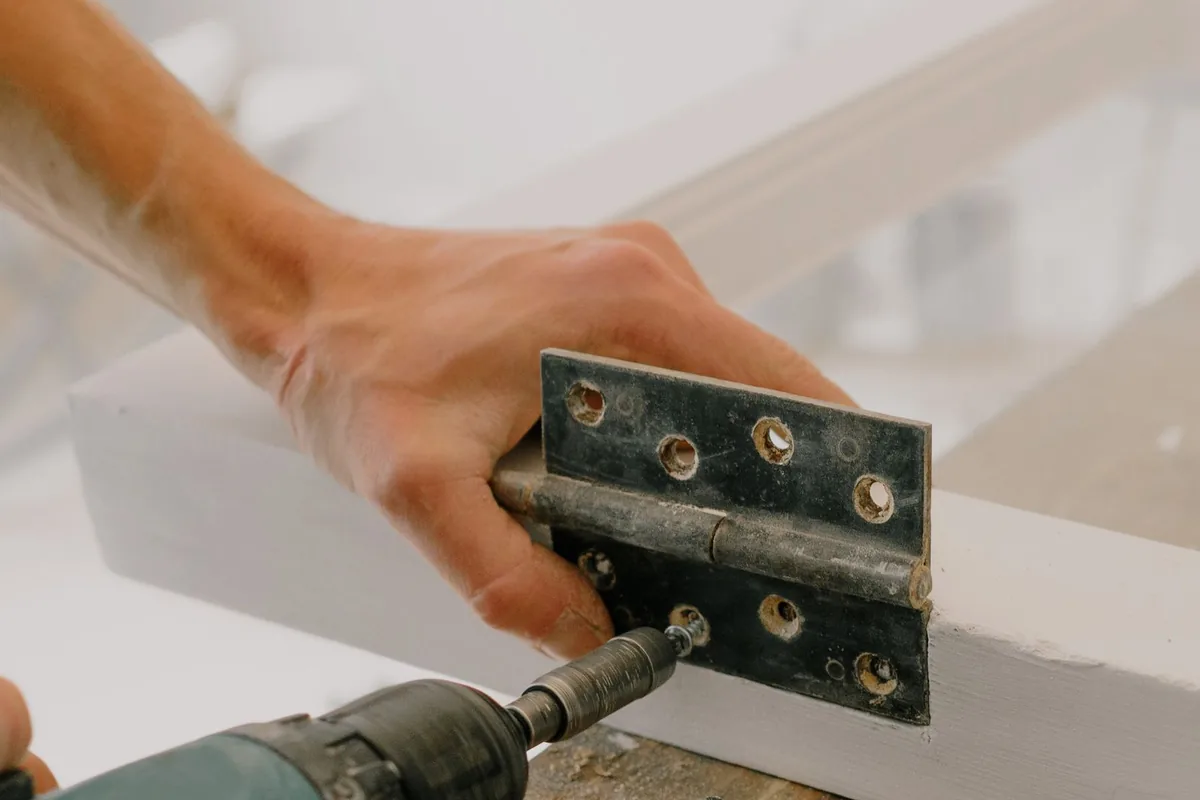
Corrosion is the hardware failure mode specific to this coast, and it starts at fasteners rather than at handles.
The local context: 29.13 of Newport Beach's 52.92 square miles is water, 55.04 percent, and Newport Harbor alone holds roughly 9,000 boats. Houses on the Peninsula, on the eight harbour islands and in West Newport sit a short distance from open water, and windows get opened.
The published benchmark is section 9.6. A finished panel roughly 127 by 229 millimetres is scratched diagonally to bare metal with a razor blade, then exposed for 288 hours, twelve days, at 100 percent relative humidity and 37 to 39 degrees Celsius, inspected every 24 hours for the first 72. The pass condition is no blisters and rust creepage from the scratch no greater than 1.6 millimetres, 0.0625 inch.
That test is written for metal cabinets, and this page says so rather than overstating it. Its value here is as a question to put to a supplier: what standard was this tested to, and what were the results? A component that would survive twelve days at 100 percent humidity with a scratch through its coating is specified for a coastal house. One with no answer is specified for a catalogue photograph.
The failure order is consistent and worth knowing. Fasteners first, because a screw head has a coating damaged by the driver and a small exposed area. Then slide runners, a large steel area that moves and wears. Then hinge cups and mounting plates. Handles last, because they are the most visible and therefore usually the best finished. Specifying excellent handles and ordinary screws is the standard way to get this backwards.
One further point about living finishes. Unlacquered brass and similar finishes are designed to patinate, and in a coastal house they will do so considerably faster than the product photographs suggest. That is not a fault, but it should be a decision rather than a surprise.
Pulls and knobs: proportion, position and the hand
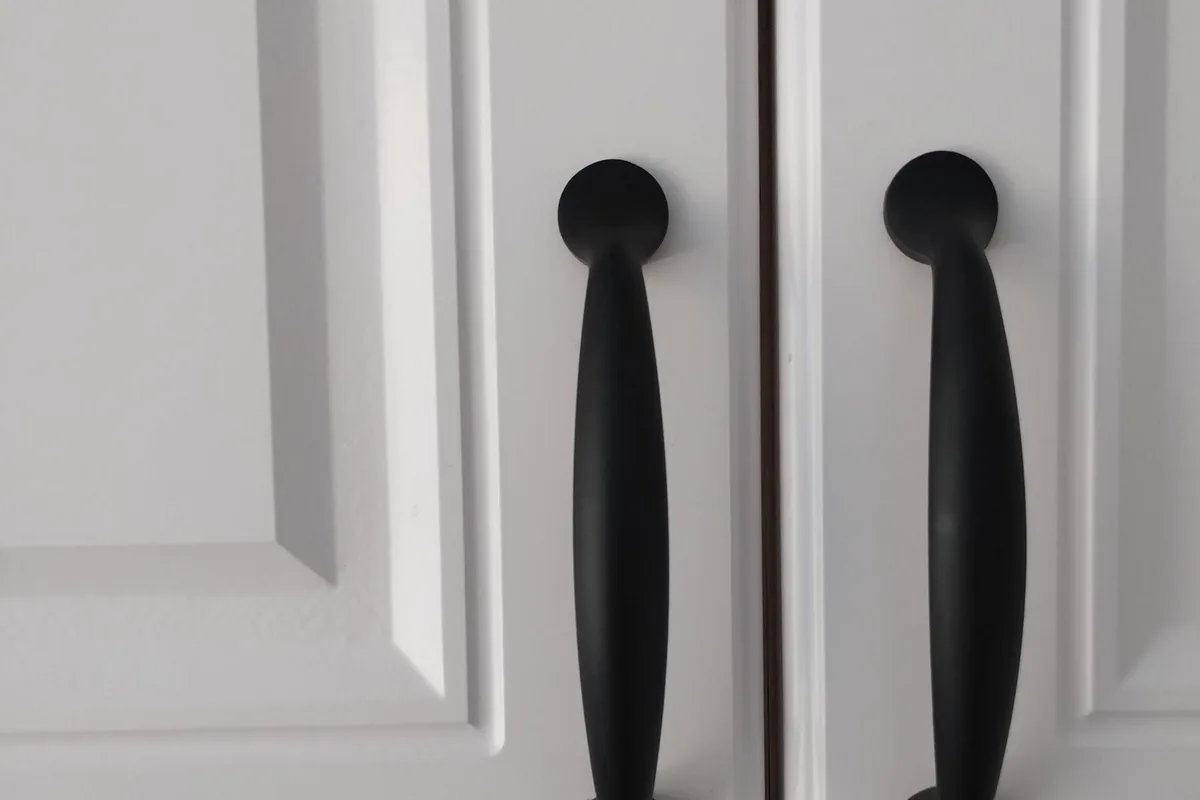
Pull length is roughly a third of the door width and a third to a half of the drawer width, and consistency across the run matters more than the exact figure.
The visual rule exists because a pull that is too short on a wide drawer reads as mean and a pull that is too long on a narrow door reads as clumsy. On a run of mixed widths, the usual approach is two or three pull lengths rather than one, with the lengths assigned by element width so the proportions stay constant.
Position matters as much as size and is easier to get wrong. On a door, a vertical pull sits on the opening stile, typically aligned with the rail of a shaker door. On a drawer, a horizontal pull sits centred, or in a column aligned with the pulls above and below. The single most important thing is a drilling jig: pulls marked by eye across a kitchen will be visibly inconsistent, and the holes cannot be moved.
There is a usability dimension too. The published accessibility guidance requires operable parts to be operable with one hand, without tight grasping, pinching, or twisting of the wrist, with an activating force of 5 pounds maximum. That is not a requirement in a private kitchen, but it is a useful test. A small round knob on a heavy pan drawer fails all three parts of it, and in a city where 24.1 percent of residents are 65 or older that is worth weighing against the look.
What hardware costs, and why it is the most elastic line
Published Newport Beach figures put knobs and hinges at $2 to $4 each, rising to $20 to $50 for premium hardware. That is a factor of more than ten on the same function.
Run it through a twelve-cabinet kitchen. Twenty-four to thirty hinges plus twenty to thirty pulls and knobs is roughly fifty pieces. At the low end that is around $150. At the premium end it is between $1,000 and $2,500, which on the same published figures can exceed the entire refacing labour line of $969 to $1,712.
That elasticity is not a reason to buy the cheapest. It is a reason to decide deliberately where the money goes. The defensible allocation, in order: slides rated properly for the heavy drawers, because that is the component carrying real load; hinges with soft-close and enough of them, because that is what the published test is about; corrosion-resistant fasteners, because they are nearly free and they fail first; and then pulls, which are the most visible and the least structural.
For context on the wider project, Thumbtack's national figures put installation at about $100 per cabinet box and finished ends at $100 to $200 each, which puts a premium hardware package in the same order of magnitude as several other whole line items. The full cost picture is in the Newport Beach cabinet cost guide.
Next steps
Hardware is usually specified alongside the cabinetry, so start with custom cabinets or kitchen cabinets. If the fronts are being changed too, the doors and drawer fronts page covers the overlay and boring question. For the coastal specification in more depth, read the marine-grade cabinets guide. Coverage is on the service area page, and a quote starts at the contact page.