When repair is the right answer, and when it is not
Repair is right when one or two things have failed in a run that is otherwise sound, and wrong when the carcasses themselves have gone. That is a short test and it holds up well in practice.
No published city-level cost range exists for cabinet repair in Newport Beach, and this site does not invent one. What it can do is put repair next to the published alternatives. Refacing twelve cabinets is $1,561 to $2,457 locally in laminate. Refinishing is $995 to $5,537. Painting is $981 to $5,459. A repair bill that approaches a meaningful fraction of those figures is a signal to stop and reconsider rather than a bargain.
| Check | What you are looking for | Verdict if it fails |
|---|---|---|
| The sink base bottom | Softness, swelling, darkening, or a lifted edge on the carcass bottom | Replace at least that carcass. Water in a particleboard bottom does not reverse. |
| Shelf spans | Visible sag in the middle of any loaded shelf | Repairable individually; if several sag, the whole kitchen was under-specified and will keep doing it. |
| Hinge screw holes | Screws that will not tighten, or hinge plates that move when the door is pulled | Repairable. Dowel and re-drill, or a threaded insert. Not a reason to replace a kitchen. |
| Face frame joints and carcass squareness | Open joints, splits at the stiles, doors with reveals that taper | Repairable if a joint; a replacement if the carcass itself has racked. |
Stripped hinge screws, the commonest repair there is
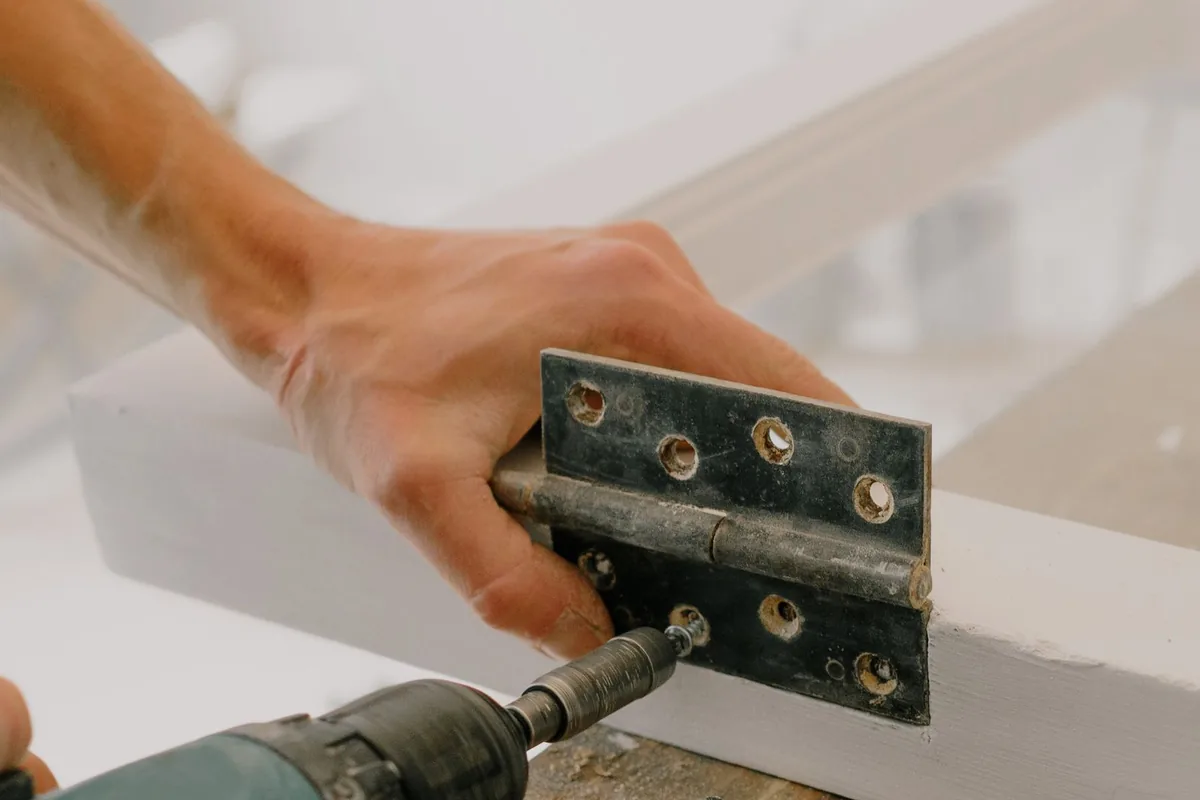
A stripped hinge screw hole is repairable in three ways, and the one thing that does not work is a bigger screw.
The failure happens because a concealed hinge plate concentrates its load into a small area of the carcass side, and every cycle of the door applies a small moment to the screws. The published test checks for exactly this: after 25,000 cycles at 20 cycles a minute, section 6.2 requires that the hardware attachment has not become loose, at either the cabinet-to-hinge or the hinge-to-door connection. In a real kitchen, a door opened thirty times a day reaches that cycle count in a little over two years.
The three repairs, in order of permanence. A hardwood dowel glued into the enlarged hole, trimmed flush and re-drilled gives fresh long-grain material for the screw to bite into and is as strong as the original, often stronger. A threaded insert set into the carcass side provides a machine thread rather than a wood thread and works particularly well in a thicker side or where the material is poor. Moving the plate slightly so that the screws find undamaged material is the quickest and, where the geometry allows it without altering the door position, a legitimate permanent fix.
What fails: a longer screw into the same hole, which finds the same damaged material further in; a fatter screw, which enlarges the hole further and often splits a thin side; and glue poured into the hole without a dowel, which has nothing to grip.
One upgrade worth considering while the hinge is off. Adding soft-close, where the hinge pattern allows it, removes the impact energy from the last inch of travel, which is precisely the force that loosened the screws in the first place. It is the only repair on this page that reduces the chance of the same failure recurring.
Sagging shelves, and the number that defines failure
A loaded shelf may deflect no more than 0.0625 inch per lineal foot between supports, with an absolute cap of 0.25 inch between any two supports. That is the published limit, measured under a 15 pounds per square foot load held for seven days.
A shelf that is visibly bowed is far past it. Three things cause it: the material was too thin for the span, the span was too long for any reasonable material, or the load exceeds what a household shelf is designed to carry. Books, tinned goods and crockery are all at the heavy end of the band.
The repairs are straightforward and the right one depends on which of the three caused it. A thicker replacement shelf in the same opening is the simplest where the span is reasonable. A front edge stiffener, a deeper lipping glued to the front edge, turns the shelf into a shallow beam and buys a great deal of span for very little visual change. A centre support or divider halves the span, which reduces deflection by roughly a factor of eight, and is the right answer in a wide opening.
A note on adjustable shelving. Pins concentrate the load at four points rather than along a bearer, so an adjustable shelf has slightly less effective capacity than a fixed one in a housing, and a pin not rated for the load will deform before the shelf does. Where several shelves have sagged in the same kitchen, checking the pins is worth the two minutes.

The sink base, and the repair that is really a replacement
A particleboard carcass bottom that has taken water has lost its structure permanently, and drying it out does not bring it back. This is the one failure on this page where the honest answer is usually replacement of something.
The failure mechanism is worth understanding because it explains why it spreads. Water sits on the cabinet bottom, soaks into the core at any unsealed edge or screw hole, and the board swells. The swelling breaks the bond between the particles, so the board loses its ability to hold a fastener. Water then tracks along the bottom rail into the adjacent carcasses. By the time there is a visible problem from the outside, two or three cabinets are often involved.
There are three sensible responses, and all three count as repair in the sense that the kitchen is not being replaced. Replace the cabinet bottom, cutting out the failed panel and fitting a new one in plywood, which is practical where the carcass sides are sound. Replace the sink base carcass entirely within the existing run, matching the external dimensions and reusing the existing door, which is the most reliable fix. Fit a proprietary sink base liner over a sound but marked bottom, which is prevention rather than repair and is worth doing in any kitchen that is staying.
The published life expectancy figures explain why this is the carcass that matters. Fannie Mae's Estimated Useful Life Tables put wood-construction kitchen cabinets at 20 years and particle board at 15, and the sink base is where that difference actually plays out. Replacing one carcass in plywood is a modest repair that removes the most likely future failure from the kitchen.
Drawer slides and the era that produced them
Most failed drawer slides in this city are epoxy-coated side-mount rollers from the 1980s and 1990s, and they are at the end of their service life rather than faulty.
That lines up with the local housing data: 11.2 percent of Newport Beach homes were built in the 1980s and 14.2 percent in the 1990s, and a kitchen from either decade that has not been replaced is running on its original hardware.
The failure sequence is consistent. The epoxy coating wears off the roller track, the roller starts to bind, the drawer is forced, and the forcing accelerates the wear and sometimes pulls the slide out of its fixings. The published test cycles a loaded drawer 25,000 times at 20 cycles a minute, opening two-thirds of its extension each time, and requires that it remain operable while still loaded. A kitchen drawer reaches that count in a handful of years, and these slides were never specified for decades of use.
Replacement is usually straightforward in like-for-like side-mount, which needs the same clearance each side and the same mounting height. Upgrading to undermount full-extension slides is a bigger job, because undermount runners require a drawer box of a specific width with a notched or rebated base to engage them. In practice that means new drawer boxes, which is a worthwhile upgrade within a refacing project and an expensive one as a standalone repair.
Splits, joints and racked carcasses
A clean split along the grain is one of the most satisfying repairs in this trade; a racked carcass usually is not repairable in any lasting way.
Wood glue in a long-grain joint produces a bond stronger than the surrounding timber, so a split that has opened cleanly along the grain, clamped properly with the glue worked in, comes back stronger than it was. That covers most splits in a face frame stile, in a door rail and in a drawer side.
A joint that has opened, a mortise and tenon or a dowelled frame joint, is harder because the glue surfaces are contaminated with the old glue. The repair is to clean the joint properly, which sometimes means taking it apart, before re-gluing. The published standard gives a target to repair back to: section 5.3 applies 113.4 kilograms, 250 pounds, to a base front joint, or 91 kilograms where specified, and requires that front joints be reliable and not open after the cabinet is in service.
A racked carcass, one that has gone out of square, is the hard case. It happens when a cabinet has been forced into an out-of-plumb opening at installation, or when a back panel has failed and the box has lost its diagonal bracing. Squaring it up afterwards means releasing the fixings, which usually means taking the countertop off, which has turned a repair into something else. The honest answer on a racked carcass is often replacement of that box.
Repair in a Newport Beach house
The lead threshold is lower than people expect
In pre-1978 housing, work for compensation that disturbs more than 6 square feet of painted surface per room stops being minor repair under the federal rule. Removing a painted component counts the entire removed surface area, and jobs in the same room within 30 days count as one job. A single hinge repair is comfortably inside the exemption. Taking a run of painted doors off and sanding them is not.
In this city that matters because of the age profile: 61.0 percent of homes built in 1979 or earlier, with the largest single decade being 1970 to 1979 at 22.3 percent. Details are in the lead paint guide.
Corrosion as a repair cause
In a city that is 55.04 percent water, hardware corrosion is a genuine repair category rather than a curiosity. Seized slides, corroded hinge pins and fasteners that shear when you try to remove them are all common on the Peninsula and the harbour islands. The published benchmark for what good looks like is the 288-hour exposure at 100 percent relative humidity and 37 to 39 degrees Celsius with a 0.0625 inch rust creep limit, which is worth applying to whatever goes back in.
Seasonal houses and discovery
48.3 percent of the city's vacant housing units are seasonal. A leak in an occupied house is noticed in a day. A leak in a house closed up for four months is noticed when somebody comes back, by which point the sink base and its neighbours have had months to absorb it. That is the single most common path from a small repair to a whole-kitchen decision in this city, and a shut-off routine before a long absence is worth more than any cabinetry.
Next steps
If the assessment points to more than a repair, the refacing page and the custom cabinets page cover the alternatives. For hardware specifically, the hardware page covers ratings and corrosion. Coverage is on the service area page, and a quote starts at the contact page.