The local seasonal band, from the published station data
The federal handbook lists only two California stations, Fresno and Los Angeles. Los Angeles is the nearest to Newport Beach, and its equilibrium moisture content runs from 9.4 percent in January to 11.7 percent in June: a 2.3-point band.
This page says which station it is using and why, because the alternative is to invent a Newport Beach figure. There is no San Diego row in the table, no Santa Ana row and no Newport Beach row. Los Angeles is what exists.
| Month | Los Angeles | Fresno |
|---|---|---|
| January | 9.4 | 15.8 |
| February | 10.2 | 13.8 |
| March | 10.5 | 11.9 |
| April | 10.4 | 10.3 |
| May | 11.0 | 8.8 |
| June | 11.7 | 7.9 |
| July | 11.6 | 7.4 |
| August | 11.2 | 7.8 |
| September | 10.8 | 8.5 |
| October | 10.6 | 9.8 |
| November | 9.8 | 12.9 |
| December | 9.9 | 15.8 |
| Annual range | 9.4 to 11.7, a 2.3-point band | 7.4 to 15.8, an 8.4-point band |
From the published equilibrium moisture content table for outside conditions in several US locations. The table note states the values were determined from the average of 30 or more years of relative humidity and temperature data, and that the relative humidity data are averages of morning and afternoon values.
Two further notes from the same source matter here. The first is the chapter's own caution, quoted: in some locations, early morning relative humidity may occasionally reach 100%. Under these conditions, condensation may occur on the wood surface, therefore surface fibers will exceed the EMC. On a harbour-front morning in Newport Beach that is not a hypothetical.
The second is the installation moisture content recommendation. For interior woodwork, flooring, furniture and wood trim the published figures are 8 percent average for most areas of the United States, with individual pieces 6 to 10 percent; 6 percent for a dry southwestern area, 4 to 9 percent; and 11 percent for a damp, warm coastal area, 8 to 13 percent. Which of those three zones Newport Beach falls in is assigned by a map figure that this page has not read, so all three are quoted and none is claimed. The table also footnotes that to obtain a realistic average you should test at least 10 percent of each item.
The worked sum: a 20-inch inset door
Multiply the door width by the species tangential coefficient by the 2.3-point band, and compare the result with the reveal you were planning to leave.
The published coefficients give dimensional change per 1 percent moisture content change, based on the dimension at 10 percent moisture content, valid between 6 and 14 percent. For a 20-inch-wide inset door across the Los Angeles band the arithmetic is 20 × coefficient × 2.3.
| Species | Tangential coefficient | Movement across 2.3 points | Multiple of a 0.0625 inch reveal |
|---|---|---|---|
| Sugar maple | 0.00353 | 0.162 inch | 2.6 times |
| Northern red oak | 0.00304 | 0.140 inch | 2.2 times |
| Black walnut | 0.00274 | 0.126 inch | 2.0 times |
| Black cherry | 0.00248 | 0.114 inch | 1.8 times |
| Sugar pine | 0.00194 | 0.089 inch | 1.4 times |
| True hickory | 0.00411 | 0.189 inch | 3.0 times |
| White oak | 0.00376 | 0.173 inch | 2.8 times |
| American beech | 0.00431 | 0.198 inch | 3.2 times |
| Yellow poplar, paint grade | 0.00289 | 0.133 inch | 2.1 times |
| Red alder | 0.00256 | 0.118 inch | 1.9 times |
| Yellow birch | 0.00338 | 0.155 inch | 2.5 times |
| Coast Douglas-fir | 0.00267 | 0.123 inch | 2.0 times |
Coefficients from the published table of dimensional change coefficients for shrinking or swelling within 6 to 14 percent moisture content. Arithmetic shown rather than asserted: movement equals width times coefficient times the 2.3-point band.
Every species in that table exceeds a sixteenth-inch reveal, which is the honest headline. The spread between the calmest and the busiest is more than a factor of two, which is why the species choice matters on inset work. And none of this is a problem on a full-overlay door, because an overlay door's reveal is between it and its neighbour and is adjustable at the hinge.
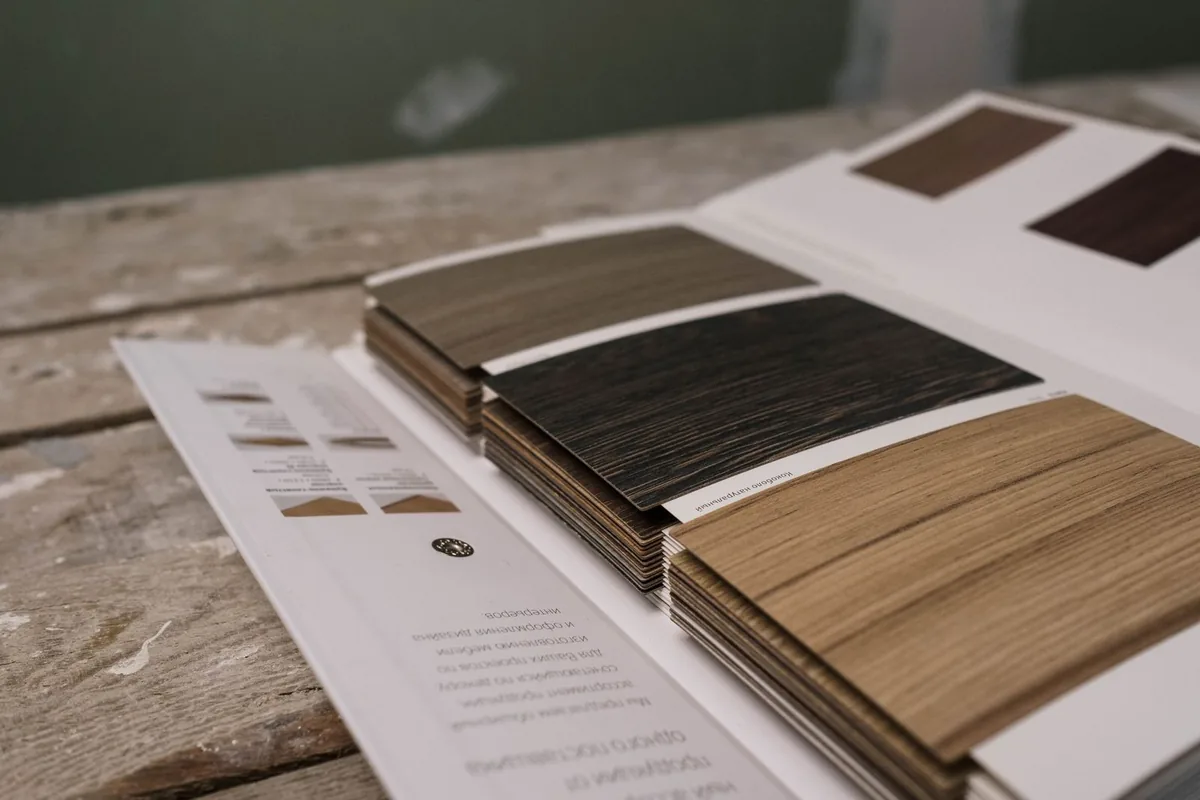
The species, one by one
Each species is a trade between appearance, hardness, finish behaviour and movement, and the right answer changes with the door detail and with whether the house is occupied year round.
Maple
Close-grained, pale, hard and the default choice for painted work because the grain does not telegraph through paint. Sugar maple's tangential coefficient of 0.00353 is high, giving 0.162 inch on a 20-inch door, so it is a strong choice for overlay doors and painted frames with stable panels, and a poor choice for a wide solid inset panel in a seasonal house. Red maple is calmer at 0.00289.
Oak
Open-grained, hard, inexpensive relative to the alternatives and unmistakable. Northern red oak at 0.00304 gives 0.140 inch; white oak is busier at 0.00376 and 0.173 inch. The open grain is the practical issue for painted work, because it needs filling to look flat, and the filling is labour that is easy to under-quote. For stained or clear-finished work in a traditional Newport Beach house it remains a sound choice.
Cherry
One of the calmest cabinet hardwoods at 0.00248, giving 0.114 inch on a 20-inch door, with a fine close grain that takes a clear finish beautifully. Its complication is not movement but colour: cherry darkens with light exposure, so a kitchen with one wall of glass will develop an uneven tone unless the whole room sees similar light. In a south-facing Corona del Mar or Peninsula room that is a real planning consideration.
Walnut
Dark, stable and expensive, at 0.00274 and 0.126 inch. Its radial coefficient of 0.00190 is unusually close to its tangential figure, which means it is comparatively well behaved whichever way a board is cut, and that is a genuine advantage on a wide panel. It is the species most often specified where the cabinetry is meant to read as furniture.
Alder
Calm at 0.00256 and 0.118 inch, soft, and often the most cost-effective way to get a real timber inset door that behaves. Its softness is the trade: it dents, which matters on a drawer front at hip height in a busy family kitchen more than it does on an upper door.
Hickory
The hardest and the busiest, at 0.00411 and 0.189 inch, with dramatic colour variation between heartwood and sapwood. It is a legitimate choice for a rustic overlay kitchen and close to the worst available choice for a wide inset panel on this coast.
Paint-grade poplar
At 0.00289 and 0.133 inch it moves more than people assume for a paint-grade timber, but its close grain and low cost make it the standard choice for painted frames. Paired with an MDF panel, which barely moves across its width, the resulting painted door is the most stable combination that is still buildable in timber.
Matching the species to the detail
The decision is not species alone; it is species plus overlay plus panel construction, and the three together determine whether the door is a problem.
| Detail | Movement exposure | Species guidance |
|---|---|---|
| Full overlay, five-piece frame with MDF panel | Lowest. The reveal is between doors and is adjustable at the hinge; the panel barely moves. | Any species. Choose on appearance and hardness alone. |
| Full overlay, solid timber panel | Low. The panel floats in the frame, so its movement is absorbed in the groove. | Any species, with a wider groove allowance on the busier ones |
| Partial overlay | Low to moderate, depending on how much frame is exposed | Any species; keep the reveal generous on maple, white oak, beech and hickory |
| Inset, five-piece frame with MDF panel | Moderate. The frame itself moves and sets the reveal. | Cherry, walnut, alder or a calmer softwood. Wider tuned reveals on anything busier. |
| Inset, solid timber panel | High. Frame and panel both move, and the reveal is visible on all four sides. | Cherry, walnut or alder, with the reveal set for the summer figure rather than the installed one |
| Beaded inset | Highest. The bead narrows the visible margin further. | The calmest species available, acclimatised in the house, and an honest conversation about seasonal reveals |
The overlay side of this decision is covered in full on the door styles and overlays guide.
The seasonal-house complication, which is this city's own
48.3 percent of Newport Beach's vacant housing units are seasonal, against 33.5 percent across the wider region, so a large share of the city's kitchens sit closed and unconditioned for months.
That is the fact that makes the outdoor equilibrium moisture content table the right reference here rather than a narrower indoor figure. A conditioned, occupied house holds a much tighter humidity range than the outdoor data suggests. A house that is shut up from October to May does not: it tracks the outside, which is precisely what the 9.4 to 11.7 percent band describes, and the chapter's 100-percent-morning caution applies to it directly.
Grain, paint and the finish interaction
Open-grained species telegraph through paint, so a painted kitchen in red oak or hickory needs grain filling, and the filling is labour that is frequently under-quoted.
That is the practical reason painted kitchens are built in maple, poplar and MDF rather than in oak. The aesthetic argument is secondary; the labour argument is decisive.
There is a local regulatory twist worth knowing, because it pushes in the same direction. Newport Beach sits inside an air district whose coating rules allow a clear topcoat 0.35 pounds of volatile organic compounds per pound of solids but a pigmented topcoat only 0.25, and a pigmented primer only 0.21 against a clear primer's 0.36. In other words, the painted finishes this market asks for most have a 30 to 40 percent tighter solids budget than clear ones. That is covered on the finishes and VOC rules guide.
Hardness, and where it actually matters
Hardness matters on horizontal and hip-height surfaces and hardly at all on upper doors, so it is worth spending on selectively rather than uniformly.
The places that take damage in a real kitchen are drawer fronts at hip height, the edges of a tall pantry door that gets knocked by trolleys and bags, and any front next to a doorway. The places that do not are upper cabinet doors, interiors and anything above shoulder height.
That suggests a mixed specification in a family house: a harder species or a tougher finish on the base and tall fronts, and a calmer, cheaper or softer species where only appearance matters. The published impact tests give a benchmark for the assembly rather than the species, at a 10-pound sandbag dropped 12 inches on a base cabinet front and door, and a 3-pound steel ball dropped repeatedly on shelves, bottoms and drawer bottoms.
Next steps
For the door detail this all hinges on, see the door styles and overlays guide. For the carcass material, see plywood against MDF against particleboard, and for the doors themselves, doors and drawer fronts. A quote starts at the contact page.