What this standard is, and what it deliberately is not
KCMA A161.1-2022 is a published performance standard that tells you what a cabinet has to survive, stated as numbers with pass conditions. It is the single most useful document a cabinet buyer can read, and almost nobody selling cabinets mentions it exists.
Its own scope section is unusually clear about its limits. It states that it "covers factory assembled, kitchen and vanity cabinets", that it is "a performance and construction standard only" and "not intended to specify cabinet design (mechanics or appearance) or materials", and that it is "intended to be used to evaluate and measure how well a factory assembled cabinet can be expected to perform when properly installed in accordance with manufacturer's instructions, normally used, and maintained".
That material neutrality is a strength rather than a gap. A frameless cabinet and a face-frame cabinet, a plywood carcass and a well-made MDF one, are all judged by what they do under load and under use rather than by the name of the material on the specification.
Section 2: what a cabinet has to be, before anything is tested
The construction requirements come before the tests, and most of them can be checked by hand on a showroom cabinet in under a minute.
| Clause | Requirement | The named exceptions |
|---|---|---|
| 2.1 Wall cabinets | Fully enclosed with backs, bottoms, sides and tops | Backs not required on vanity units of all types, kitchen sink fronts, kitchen sink bases, and cabinets designed to house ovens and refrigerators |
| 2.1 Base cabinets | Fully enclosed with backs, bottoms and sides | Bottoms not required on oven cabinets, refrigerator cabinets, kitchen sink fronts, vanity bowl fronts, kitchen drawer units and vanity drawer units. Sides not required on sink fronts and vanity bowl fronts except where a side is exposed. |
| 2.2 Equipment access | Cabinets containing water heaters or other equipment must have access panels for servicing or replacement | None stated |
| 2.3 Toe space | Where a toe kick is designed in, at least 51 mm (2 inches) deep and 76 mm (3 inches) high | Measured from the face of the face frame or the side edge of the cabinet side, and from the bottom edge of the cabinet side |
| 2.4 Utility cabinets | Same requirements as wall cabinets, fully enclosed with backs, bottoms, sides and tops | None stated |
| 2.5 Doors and drawers | Properly aligned with the cabinet; closing without excessive binding or looseness; functioning effectively with typical industry hardware such as hinges and drawer slide systems | None stated |
Source: KCMA A161.1-2022, section 2, Kitchen Cabinet Manufacturers Association.
The toe space figure is the one most worth remembering, because it is the dimension that decides whether a counter is comfortable to stand at. Two inches deep and three inches high is the minimum, and a shallow toe space is the quiet reason some kitchens are tiring to work in.
Section 8: the finish and appearance requirements
Section 8 is where the standard addresses the details that separate a well-made cabinet from a cheap one at a glance.
- All exterior exposed parts of cabinets, except toe space and parts normally covered after installation, shall have nails and staples set and the holes filled
- All interior exposed surfaces shall be free of saw marks and poor workmanship, and shall be covered with a decorative film or paper material or have a minimum of one coat of clear or pigmented finish
- Sides do not have to be finished on individual units, but exposed sides as installed must be factory finished or covered with factory finished panels in the field
- Toe space and kick do not have to be finished but must be covered or finished in the field
- Undersides of wall cabinet bottoms are interior exposed surfaces and must comply with the interior finish provision
That last one is the single most commonly skipped detail in cheap cabinetry, and it is the first thing you see when you stand at a counter and look up. A raw or unfinished wall cabinet underside is a cabinet that was built to a price.
Section 5: the structural tests, and what they mean in a kitchen
Five structural tests, and the first two are the ones a real kitchen tests every day.
5.1 Static loading on shelves and cabinet bottoms
The method: mount the cabinets per the manufacturer's instructions. Place a 3 pound sandbag approximately centred on the shelves to allow for settlement of the shelves and the shelf mounting devices. Apply deflection measuring instrumentation. Load all shelves and cabinet bottoms uniformly at 718 Pa, 15 pounds per square foot, arranged to avoid a bridging effect. Maintain the loading for seven days.
The pass condition: no visible sign of joint separation or failure in any part of the cabinets or the mounting system, and the loaded shelves and bottoms shall not deflect more than 1.6 mm (0.0625 inch) per 305 mm (lineal foot) between supports, with a maximum deflection of 6.4 mm (0.25 inch) between any two supports.
In practice that is why a 36-inch shelf of tinned goods in three-quarter material is comfortable and a 42-inch shelf of the same material is marginal. Fifteen pounds per square foot is approximately a shelf of books or of canned food, which makes a pantry and a bookcase the two places this limit bites first.
5.2 Static loading for mounted wall cabinets and wall-hung base cabinets
The purpose, in the standard's words, is "to assure that wall cabinets will not have excessive structural damage and remain fastened to the wall with extra loading beyond shelf and bottom loading". It applies to mounted wall cabinets and wall-mounted base cabinets 24 inches in height or greater.
The method: mount the cabinet, invert it so the top is in contact with the loading device, place the loading device on the centre of the front, and apply the load slowly, taking four minutes to reach 272 kg (600 pounds), at 150 pounds per minute for cabinets wider than 36 inches.
| Cabinet width | Net load applied | Pass condition |
|---|---|---|
| Wall cabinets and wall-hung base cabinets up to 36 in. | 272 kg (600 lb) | No visible sign of failure in the cabinet or the mounting system |
| Wall-hung base cabinets 36 to 60 in. | 363 kg (800 lb) | Same |
| Wall-hung base cabinets greater than 60 in. | 9 kg per inch of width (20 lb per inch) | Same |
Source: KCMA A161.1-2022, section 5.2. The phrase 'or the mounting system' is the part that matters most: the standard refuses to separate a cabinet from its fixing.
That phrase, "or the mounting system", is the whole practical lesson. A perfectly built carcass hung on drywall anchors fails this test, and it fails slowly in a real kitchen too, as the anchors work their way out of the board under load and vibration.
5.3 to 5.5: joints and impacts
| Test | Purpose, in the standard's words | Applied |
|---|---|---|
| 5.3 Base front joint loading | To test the strength of base-front joints to withstand stresses applied when joining modular cabinets, and to ensure reliable front joints that will not open after the cabinet is in service | 113.4 kg (250 lb) to the rail, or 91 kg (200 lb), applied over minutes |
| 5.4 Impact on shelves, cabinet bottoms and drawer bottoms | To withstand the dropping of objects in normal use | A 1.36 kg (3 lb) steel ball dropped, repeated between supports and centred on a drawer bottom |
| 5.5 Impact on base cabinet front and door | To withstand impact in normal household use | A 4.54 kg (10 lb) sandbag at a 305 mm (12 in.) drop |
Note how ordinary those impacts are. A three pound steel ball is a dropped jar. A ten pound sandbag from a foot is a knee into a base door while carrying something. The standard is not simulating abuse, it is simulating Tuesday.
Sections 6 and 7: doors and drawers, 25,000 times
The cycle tests are the ones that describe real wear, and almost everything they check afterwards is a hinge, a slide or a fixing.
6.1 Door racking and hinge loading
The method: slowly apply 29.5 kg (65 pounds) of weight on the door, 14.75 kg (32.5 pounds) on each side, at 254 mm (10 inches), then run 10 cycles from 90 degrees open, weighting the door for 10 minutes. At the end, return the door to 90 degrees, wait 10 minutes, and examine. The pass condition is that the door shape is unchanged.
This is the child-hanging-off-the-door test, and it is the one that exposes a door hung on too few hinges or a door built with stapled rather than jointed corners.
6.2 Door, door-holding and hinge operation
The method: one cycle consists of a full open and close. 25,000 cycles at a speed of 20 ± 2 cycles per minute.
The pass conditions, all five of them:
- The door still functions and the door-holding or closure device is still adequate to hold the door in the closed position
- The door shape is the same as before the test, as recorded before it began
- The measurement at the sag point is no more than 1.6 mm (0.065 inch)
- The hinges show no visible sign of damage or loss in functionality
- The hardware attachment has not become loose, at either the cabinet-to-hinge or the hinge-to-door connection
The fifth condition is the one that matters most and the one that explains soft-close hardware better than any sales pitch. The last inch of a door's travel is where the impact energy goes into the hinge cup screws, and over 25,000 cycles that repeated impact is what works the attachment loose. A soft-close mechanism removes the impact; the quiet is a side effect.
7.1 and 7.2: drawer operation and closing impact
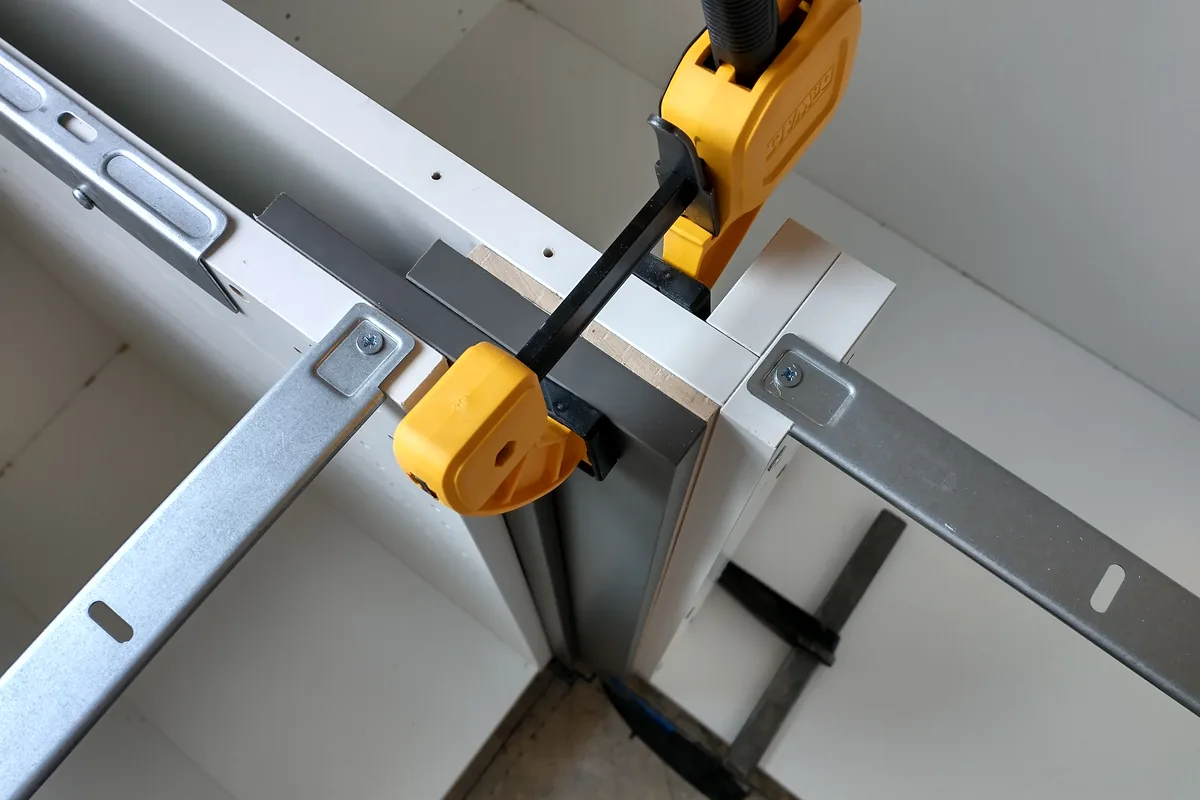
The drawer test mirrors the door test with a load added. Tighten all screws, load the drawer uniformly at 718 Pa, 15 pounds per square foot, then operate it through 25,000 cycles, each cycle opening the drawer two-thirds of its extension length and returning it closed, at 20 cycles per minute ± 2, with the cycling mechanism attached so that no additional loads are placed on the drawer.
Three pass conditions:
- After the 25,000 cycles, and while still loaded, the drawer remains operable with no loss of functionality
- There is no failure in any part of the drawer assembly or operating system
- The drawer bottom has not deflected to a position that interferes with drawer operation
That third condition is about the drawer base rather than the runner, and it is a common real-world failure: a thin base panel in a groove, loaded with heavy items, bows downward until it fouls the slide. Section 7.2 then separately tests the drawer-front assembly against the drawer-closing impact normally expected in household usage, with the drawer mounted in a test stand and clamps attached to the drawer sides.
Section 9: the finish tests, which describe a kitchen precisely
The finish tests are introduced as creating, in accelerated form, the cumulative effects of years of normal kitchen conditions on factory finished cabinets. They are run on a cabinet door representative of a normal production run, and critically all tests are run on new surfaces after the cabinet finish has aged a minimum of ten days.
9.2 Shrinkage and heat resistance
Purpose, quoted: to test the ability of the finish "to withstand high heat for long periods, such as inside truck, boxcar or other transport or storage facility; or in service under normal kitchen conditions". Method: stabilise the door at room temperature and humidity for 24 hours, then place it in a hotbox at 49 °C ± 3 °C (120 °F ± 5 °F) and 70 percent ± 5 percent relative humidity for 24 hours. Pass: no discoloration, no evidence of blistering, no checks.
9.3 Hot and cold check resistance
Method: one hour in the hotbox at 120 °F and 70 percent humidity, half an hour at room conditions, one hour in a cold box at -21 °C ± 3 °C (-5 °F ± 5 °F), then back to room conditions. Repeat for a total of five cycles. Pass: no discoloration, blistering or checks.
9.4 Chemical resistance
This is the test worth quoting at a cabinet maker, because it is a precise description of a kitchen in use. On the door, face frame, drawer front and drawer side, with the cabinet in its normal vertical position, place 1 cc ± 0.5 cc of each of:
- Lemon juice, orange juice and grape juice
- Tomato ketchup
- Coffee, prepared for drinking at 46 °C (115 °F ± 5 °F), with one teaspoon of instant coffee in one cup of water
- Vinegar
- Olive oil
- 100-proof alcohol
- The standard's detergent solution
All of those are read at 24 hours. Mustard is applied and read at one hour. The surfaces are then sponge washed with clear water, dried with a clean cloth and examined. The pass condition: "There shall be no discoloration, stain, or whitening that will not disperse with ordinary polishing".
9.6 Metal cabinet rust resistance
Written for metal cabinets specifically, and the clearest published corrosion benchmark available for a coastal house. Method: take a finished end or a section of one, approximately 127 mm by 229 mm (5 by 9 inches), from regular production. Scratch the back of the panel diagonally from corner to corner with a razor blade to bare metal. Expose for 288 hours (12 days) at 100 percent relative humidity and 37 °C to 39 °C (98 °F to 102 °F), inspecting every 24 hours for the first 72.
Pass: no blisters on the test unit, and rust creepage from the edges of the scratches no greater than 1.6 mm (0.0625 inch).
The deliberate scratch is the clever part. It accepts that coatings get damaged in real use and measures how far corrosion travels from the damage, rather than whether an undamaged coating holds. In a city that is 55.04 percent water, that is exactly the right question to put to a hardware supplier. More on that in the marine-grade cabinets guide.
9.7 Water holdout of interior surfaces
Purpose: to test the durability of internal shelves against residual water and heat damage. Method, in sequence: a shelf in a horizontal position; a ceramic coffee cup; a flat-bottomed vessel filled with 0.5 inch of water; heat the water to boiling then turn the heat off and wait five seconds; turn the cup upside down and dip it so the top half inch is immersed in the hot water; remove after 2 ± 0.5 seconds; wait 5 ± 1 seconds; place the cup upside down on the shelf. After 24 hours, remove the cup and check the shelf.
Pass: no delamination or swelling, and no discoloration, blistering, checking or whitening in the finish.
In several of these finish tests, the standard permits that "in the event of failure during initial examination, the tested parts shall be permitted to stand for 14 days and then shall be reexamined for the same performance requirements", which is a recognition that coatings keep changing after application.
How to actually use this in a showroom
Ten of the construction and appearance requirements can be checked by hand on a display cabinet in under a minute, and the test figures turn the rest into specific questions.
| Look at | What you are checking | What a failure looks like |
|---|---|---|
| The top of a wall cabinet | 2.1 fully enclosed | A missing top you can see from below |
| The back of a base cabinet beside the sink base | 2.1 fully enclosed | An open back or a thin insert |
| Your toe against the plinth | 2.3 toe space, 2 in. deep and 3 in. high | A shallow kick that makes the counter uncomfortable |
| A run of doors sighted from one end | 2.5 alignment | Reveals that grow and shrink along the run |
| A drawer opened fully and released | 7.1 operation | Grinding, drop-off, or a base that touches the runner |
| A fingertip along a stile | 8.1.2 nails and staples set and filled | Proud fasteners or open holes |
| Inside a door frame and a back corner | 8.1.3 interior exposed surfaces finished | Raw board or visible saw marks |
| The end of the run beside a doorway | 8.1 exposed sides finished | A bare carcass side |
| Standing at the counter looking up | 8.1.3 wall cabinet undersides | Raw board overhead |
| The hinge count on the tallest door | 6.2 sag limit of 0.065 in. | Two hinges on a tall or heavy door |
The questions worth asking out loud, once the visual check is done: what shelf thickness and span do you use, and does it meet the 0.0625 inch per lineal foot deflection limit? What is the drawer slide load rating? Has your finish system been tested against the chemical resistance panel? And, for a house near the water, what corrosion standard was the hardware tested to?
Where to go next
To apply these numbers to a real project, start with custom cabinets or kitchen cabinets. For the hardware side specifically, the cabinet hardware page covers ratings and corrosion. For what the box should be made of, read the box materials guide.