Put the drop zone on the path people already walk
A drop zone only works if it is in the first three feet inside the door the household actually uses, which in Newport Beach is frequently the garage door rather than the front door.
This is the design decision that determines whether the joinery gets used or becomes expensive decoration, and it is made by watching the house rather than by reading the plan. Beach-city traffic patterns are specific: people come back from the sand through whichever door is nearest, carrying things that are wet and sandy, and they put them down within a step or two of stopping. Joinery two steps off that line is ignored.
That has a practical consequence for the brief. A full mudroom is lovely and it is not always available. A 12-inch-deep run of hooks, a bench and baskets in a garage entry is narrow, undramatic and does the entire job. Garage-adjacent drop zones are covered further on the garage cabinets page, because the two are usually the same project.
Bay width, bench height and the numbers that matter
Measure the widest thing that will hang in each bay, not the number of people, because a locker that is too narrow for a wetsuit is a locker that holds a coat instead.
| Element | Dimension | What decides it |
|---|---|---|
| Coat locker bay width | 14 to 18 inches per person | A hanging coat on a hook, with room to get a hand in beside it |
| Wetsuit or wet-gear bay width | 18 to 24 inches | Neoprene does not compress and a wetsuit on a wide hanger needs real shoulder room |
| Bench seat height | 17 to 19 inches to the top of the seat | Standard seat height, because the bench exists so shoes come off sitting down |
| Bench depth | 15 to 18 inches | Shallower and people perch instead of sitting, which defeats the point |
| Hook rail height for adults | 60 to 68 inches above the floor | Comfortable overhead reach without a long coat touching the bench |
| Hook rail height for children | 40 to 48 inches above the floor | The published unobstructed reach range tops out at 48 inches, which is a useful ceiling for a child's hook |
| Basket shelf opening height | 10 to 14 inches | A basket deep enough for shoes, shallow enough that the contents stay visible |
| Plinth recess depth | 2 to 3 inches, swept rather than sealed | Sand has to be able to leave, which it cannot do from under a flush base |
These are design dimensions for planning, derived from standard seat heights and from the published reach ranges. Every job measures the actual gear that will live in the lockers.
The reach figures are a useful cross-check rather than a requirement in a private home. The published unobstructed forward reach range is 15 to 48 inches above the floor, with the maximum dropping to 44 incheswhere the reach passes over an obstruction between 20 and 25 inches deep. For a child's locker, keeping the hook and the basket inside that band is the difference between a system they use and one an adult has to operate for them.
Why the lockers stay open
Wet gear needs air moving over it, so an open bay dries and a closed bay rots. That is the whole argument, and it runs against instinct because closed looks tidier.
Materials, because this is where mudrooms fail
Use exterior or marine-grade plywood wherever water reaches, seal every edge including the undersides, and keep particleboard and MDF out of the base of a locker entirely.
The failure sequence is always the same. Water reaches an unsealed edge, the core swells, the swelling is permanent, and the panel face lifts. In a kitchen that happens under a leaking sink base once a decade. In a beach mudroom it happens as a matter of routine, several times a week, from the gear itself rather than from a plumbing fault.
- Exterior or marine-grade plywood for locker bases, bench tops and any panel a wet item touches
- Every edge sealed, including undersides and the back edges nobody sees, because that is where water sits
- A durable film-forming finish rather than a penetrating oil, because the surface has to be wipeable
- Stainless or genuinely corrosion-rated hooks, rails and fixings, not decorative plated steel
- Baskets rather than drawers on lower shelves, because sand destroys runners
- A removable or wipeable tray in any bay where something actively drips
Whatever sheet goods are used, the state formaldehyde limits still apply. California's green building code sets maximum emissions of 0.05 parts per million for hardwood plywood with a veneer core, 0.05 for hardwood plywood with a composite core, 0.09 for particleboard, 0.11 for medium-density fibreboard and 0.13 for thin MDF, tested to ASTM E1333. In Newport Beach that code is adopted locally as a Municipal Code chapter rather than being a distant state rule, which is covered on the box materials guide.
Designing for sand
Design so sand can be swept out rather than trying to stop it getting in, because in this city it always gets in.
Three details do most of the work. The first is the plinth: a recessed toe of 2 to 3 inches that a broom reaches into, rather than a base fitted flush to the floor with a sealed joint that traps grit permanently. The second is baskets instead of drawers on the lower shelves, because a drawer runner with sand in it grinds, binds and then fails, and the published 25,000-cycle expectation for a drawer assumes clean operation. The third is leaving nothing fixed tight against the floor that cannot be lifted or swept behind.
The hardware consequence is worth stating. Where a mechanism is used in a sandy room, the specification question is not only the load rating but whether the mechanism is tolerant of grit. That is a different question from the one asked in a kitchen, and it is covered alongside the rest of the mechanism choices on the cabinet hardware page.
Salt, and what it does to a hook
Hooks, rails and fixings in a wet mudroom near the water should be stainless or genuinely corrosion-rated, because a plated steel hook in that position rusts from the fixing outward.
Newport Beach is 55.04 percent water by area, with a semi-artificial harbour and roughly 9,000 boats, and a mudroom is the room in the house that receives sea water directly rather than as humidity. The published corrosion benchmark worth asking a supplier to meet for hardware in this position is 288 hours at 100 percent relative humidity and 37 to 39 degrees Celsius on a panel scratched to bare metal, with no blisters and no more than 0.0625 inch of rust creep.
That is a higher bar than a mudroom hook usually clears, and it is the right bar here. The load case matters as much as the corrosion one: a soaking wetsuit is heavy, and the force on a coat hook is downward and outward at once, which is the direction that pulls a fixing out of plasterboard. Hooks go into located studs or a continuous backing rail, never into a cabinet back panel alone. The broader salt-air argument is on the salt air guide.
What a mudroom run costs
At the published Los Angeles band of $500 to $1,500 per linear foot installed, an eight-foot run of lockers is $4,000 to $12,000, and open construction sits toward the lower half of that.
No published source gives a Newport Beach-specific cabinetry figure, so this page uses the Los Angeles band as a Los Angeles band. Open lockers are genuinely cheaper to build than closed cupboards: no hinges, no door alignment, no second finished face and fewer reveals to keep even. That is unusual, and it means the saving can be spent on the one upgrade that matters most here, which is the sheet material.
Ask for the material upgrade as its own line. The difference between standard interior plywood and an exterior or marine grade across an eight-foot run is a visible number, and it is the single change most likely to decide whether the lockers are still sound in ten years. The cost structure is set out on the cost per linear foot guide.
Next steps
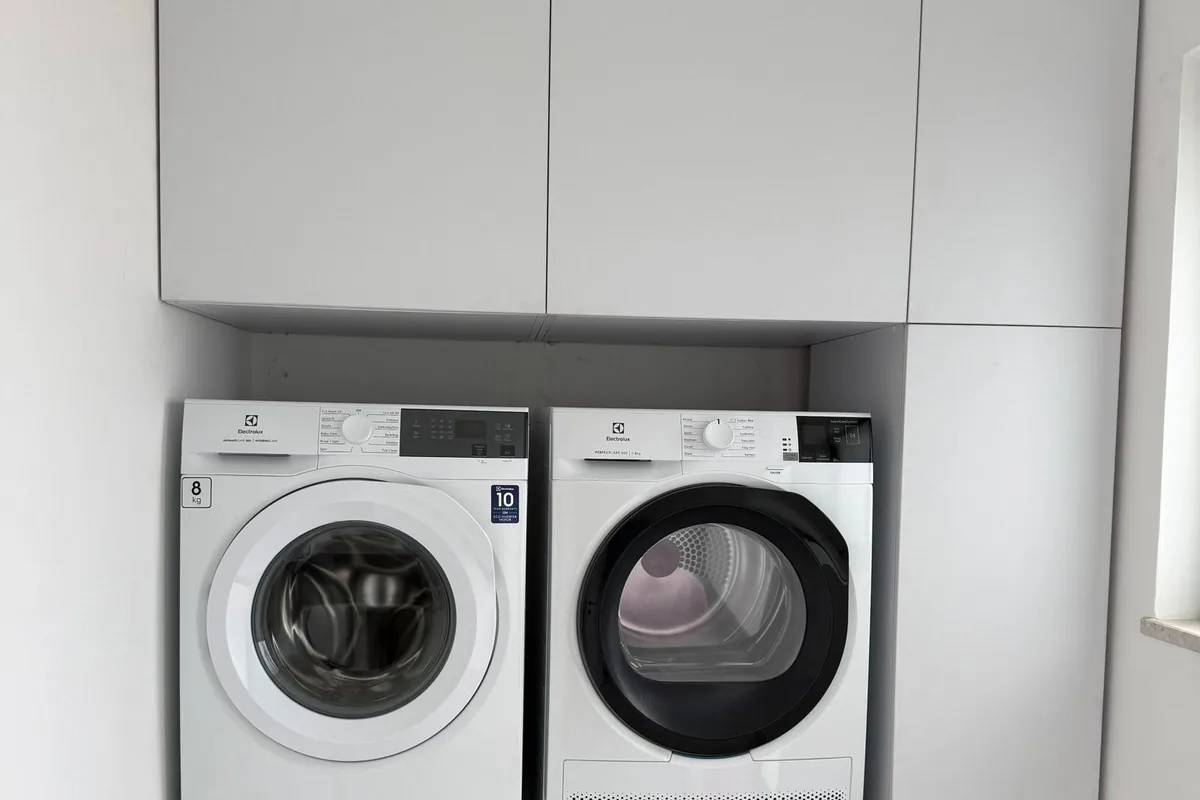
For the machines, the folding counter and the utility storage that usually sit in the same room, see laundry room cabinets. For the garage entry that is often the real drop zone, see garage cabinets, and for the whole picture, custom cabinets. A quote starts at the contact page.