The three materials, and what each one actually is
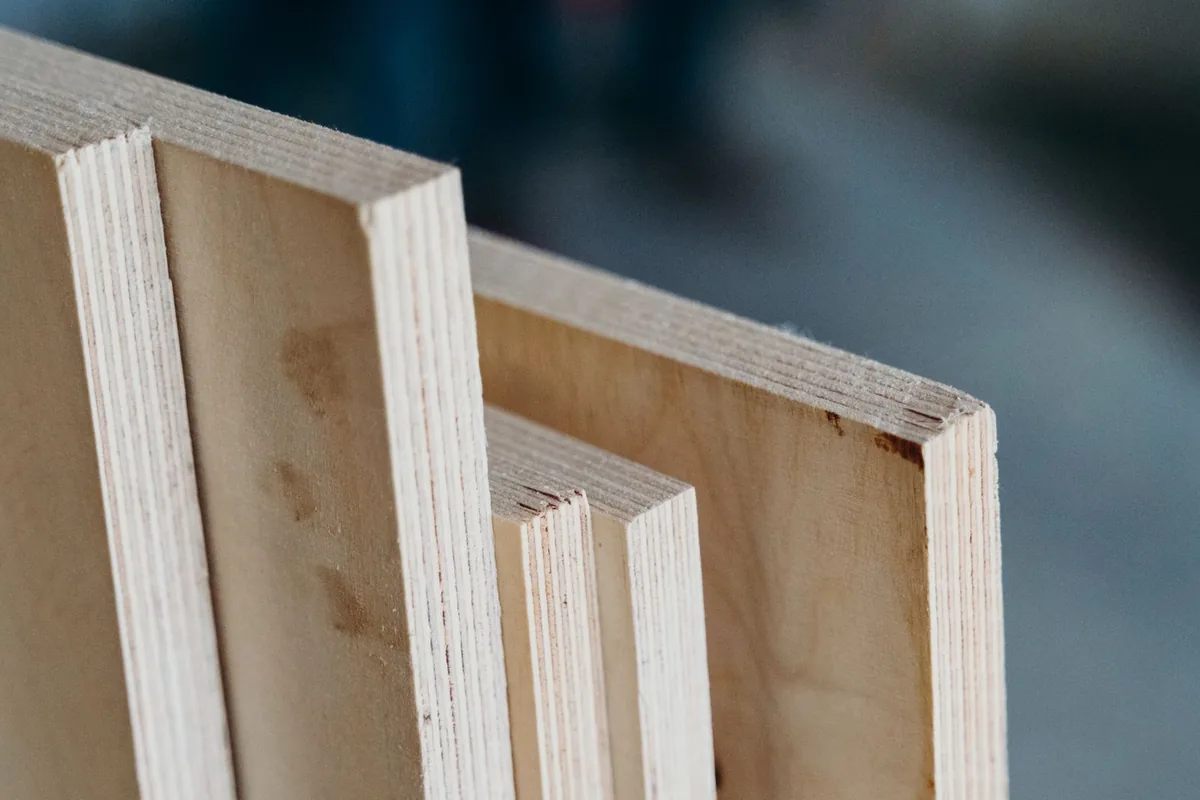
Plywood is thin layers of timber glued in alternating grain directions. Particleboard is wood chips bonded under pressure. MDF is wood fibre broken down and reformed into a dense, uniform panel.
Those three structures explain every difference in behaviour that follows, including the ones that matter in a coastal city.
| Property | Plywood | Particleboard | MDF |
|---|---|---|---|
| Structure | Cross-laminated veneers, so strength runs both ways | Coarse chips in resin, strength roughly uniform but low | Fine fibre in resin, very uniform and dense |
| Screw and fixing holding | Best, because a screw bites into continuous veneer layers | Weakest, especially on an edge, where chips crumble | Moderate on a face, poor on an edge without special fixings |
| Behaviour when wet | Swells and can delaminate, but often recoverable if dried quickly | Swells irreversibly and crumbles; the worst of the three | Swells irreversibly; absorbs through an unsealed edge rapidly |
| Weight | Lightest of the three for the same thickness | Heavier | Heaviest, which matters for a large door or a long shelf |
| Edge finish | Shows a layered edge; needs banding or a solid lipping | Needs banding; a raw edge is fragile | Takes paint directly on a machined edge, which is its best feature |
| Flatness and stability | Very good, with occasional slight bow in thinner sheets | Good while dry | Excellent, and the reason painted MDF doors stay flat |
| Published formaldehyde limit | 0.05 ppm veneer core, 0.05 ppm composite core | 0.09 ppm | 0.11 ppm, and 0.13 ppm for thin MDF |
| Where it belongs in a kitchen | Carcasses, especially the sink base; shelves in long spans | Budget carcasses in dry locations only | Painted doors and drawer fronts; never a sink base |
The last row is the summary most quotes never give. These are not three grades of the same thing; they are three materials with different right answers. A kitchen with plywood carcasses and painted MDF doors is a better specification than one that uses either material throughout.
The sink base, which decides the kitchen
The sink base is the one cabinet where the material choice determines the lifespan of the whole run, and it is also the cabinet the published standard allows to be built with the least.
The standard's construction requirements state that wall cabinets shall be fully enclosed with backs, bottoms, sides and tops, and base cabinets with backs, bottoms and sides. It then names exceptions, and the exceptions are revealing: backs are not required on vanity units, kitchen sink fronts, sink bases, oven cabinets and refrigerator cabinets, and bottoms are not required on oven, refrigerator, sink-front, vanity-bowl-front and drawer units.
So the cabinet most exposed to water is explicitly permitted to be built without a back and without a bottom. That is defensible as a construction standard, since plumbing has to pass through and a solid bottom traps a leak out of sight, but it means the material and the sealing of what is there carry all the load.
The formaldehyde limits Newport Beach adopted
Newport Beach adopted the California Green Building Standards Code as Municipal Code chapter 15.11, effective 1 January 2026, which makes the state formaldehyde limits on composite wood local law here.
The code's composite wood section requires that hardwood plywood, particleboard and medium density fibreboard products used on the interior or exterior of the building meet the formaldehyde requirements specified in the state air board's airborne toxic control measure for composite wood.
| Product | Maximum emissions, ppm | Test method |
|---|---|---|
| Hardwood plywood with a veneer core | 0.05 | ASTM E1333 |
| Hardwood plywood with a composite core | 0.05 | ASTM E1333 |
| Particleboard | 0.09 | ASTM E1333 |
| Medium density fibreboard | 0.11 | ASTM E1333 |
| Thin medium density fibreboard | 0.13 | ASTM E1333 |
Limits from the California Green Building Standards Code composite wood section, adopted in Newport Beach as NBMC chapter 15.11 by Ordinance No. 2025-23, effective 1 January 2026.
Two things are worth taking from that table. The first is that the limits get looser as the material gets less structural, which is a sensible ordering but means a thin MDF drawer bottom is permitted to emit more than twice what a plywood carcass is. The second is that this is a Newport Beach code requirement rather than an aspiration, because the city adopted the chapter. The documentation that proves compliance is something a cabinet maker should be able to produce, and asking is free.
The permit and code context for chapter 15.11 and the rest of Title 15 is on the permits and code guide.
Four published life tables that disagree
Manufacturer-sourced tables say kitchen cabinets last 50 years. The capital-planning tables that lenders underwrite against say 15 to 25. Only one of the four splits wood construction from particleboard.
That disagreement is the most honest thing available on cabinet lifespan, and it is worth showing rather than resolving, because the methods differ enough that both can be right.
| Source | Kitchen cabinets | Notes on method |
|---|---|---|
| A 2007 homebuilder association and lender study | 50 years; bath cabinets lifetime; garage and laundry cabinets 100 or more; modular or stock 50 | Based on a 2006 telephone survey of manufacturers, trade associations and researchers. Its own caveats say life expectancy is greatly affected by the quality of maintenance and is based on first-owner use. |
| A state housing agency architectural manual, 2011 | 15 years family and 20 years elderly in one section; 20 and 25 in another, with the action stated as replace | A capital-planning table for subsidised housing, written to schedule replacement rather than to predict failure |
| A federal mortgage agency's estimated useful life table, 2019 | Wood construction 20 years; particleboard 15 years; bathroom vanity 10 years | The only one of the four that splits the box material. Its preamble says the values are standardised averages and are not intended to replace professional judgement. |
| A home inspectors' association life expectancy chart | 50 years; bathroom cabinets 50 or more; garage and laundry 70 or more; modular stock 50 | A general reference chart for home inspection, closer in figures to the manufacturer-sourced study |
All four tables are reproduced in a published technical appendix on the life expectancy of building materials. Quoted as published; the disagreement between them is the point.
The practical reading is this. If you keep a house and maintain it, the manufacturer-sourced 50-year figure is not absurd. If you are planning capital expenditure or buying a house with a kitchen of unknown age, the 15-to-25-year figures are the ones to budget against. And if you want a single number to justify paying more for the box, the 20 years against 15 split is the only published one there is.
Put that against local prices. A 25-linear-foot kitchen at the published Los Angeles band of $500 to $1,500 per linear foot installed is $12,500 to $37,500, and the regional data records a median Newport Beach sale price of $1,826,000. Against those numbers, five extra years of cabinet life for a modest material upgrade is a straightforward decision, and nobody in this market writes it down.
What the published tests ask of the box
The published standard sets the same structural tests regardless of material, which converts the material debate into a set of numbers.
| Test | Load and method | Pass condition |
|---|---|---|
| Shelves and cabinet bottoms | 15 pounds per square foot uniform, after a 3-pound sandbag settles the shelf, held 7 days | No joint separation or failure anywhere, deflection no more than 0.0625 inch per lineal foot between supports and 0.25 inch maximum between any two supports |
| Mounted wall cabinets and wall-hung base cabinets 24 inches or taller | 600 pounds up to 36 inches wide; 800 pounds from 36 to 60 inches; 20 pounds per inch of width above 60 inches, applied over 4 minutes | No visible sign of failure in the cabinet or the mounting system |
| Base front joint loading | 250 pounds to the rail, or 200 pounds | Joints must not open after the cabinet is in service |
| Impact on shelves, bottoms and drawer bottoms | A 3-pound steel ball dropped, repeatedly | No failure |
| Impact on base cabinet front and door | A 10-pound sandbag at a 12-inch drop | No failure |
| Water holdout of interior surfaces | A ceramic cup dipped half an inch in just-boiled water, then stood upside down on a shelf for 24 hours | No delamination or swelling, no discolouration, blistering, checking or whitening |
The last row is the one that bears directly on material choice in this climate. A standing-water test on an interior shelf for 24 hours is exactly the condition a particleboard shelf with an unsealed edge fails, and it is also an entirely realistic household event. The full test list, including the door, drawer and finish tests, is on the quality standard guide.
Newport Beach specifics: water, seasons and salt
In a city that is 55.04 percent water by area, where 48.3 percent of vacant housing units are seasonal, box material is a durability question rather than a preference.
Two local conditions bear on it. The first is simple proximity: the harbour is semi-artificial, dredged in the early 1900s, with eight artificial islands now covered in private homes and roughly 9,000 boats in the water. A kitchen on Balboa Island or the waterfront of Lido Isle sits in a genuinely marine environment.
The second is seasonal occupancy, and it is the more interesting one. A house that stands closed for months with the air conditioning off tracks outdoor humidity rather than conditioned indoor air. The published equilibrium moisture content figures for the nearest station, Los Angeles, run from 9.4 percent in January to 11.7 percent in June, and the chapter carries an explicit caution that in some locations early-morning relative humidity may occasionally reach 100 percent, under which condensation may occur on the wood surface so that surface fibres exceed the equilibrium moisture content.
That caution is the whole case for sealing edges in this city. Condensation on an unsealed particleboard edge, repeatedly, over a seasonal cycle, in a house nobody is in, is exactly how a sink base fails unobserved. The species and movement arithmetic for the solid-timber parts is on the coastal wood species guide.
What to ask for, in order
Six items, in the order they matter, and all six are answerable in a sentence each by any shop that knows what it is building.
- The sink base material, named specifically rather than covered by a general statement about the kitchen
- Carcass material and thickness for every other cabinet, with three-quarter-inch sides the benchmark in frameless construction
- Back construction: a full panel or a thin insert, and whether it is sealed
- Whether every edge is sealed, including undersides and back edges, because that is where water enters
- Door and drawer front material, where painted MDF is often the better answer than solid timber
- The formaldehyde compliance documentation, since the limits are local code here through NBMC 15.11
Next steps
For the solid-timber side of the specification, see the coastal wood species guide. For the tier question, see custom against semi-custom and stock, and for repairs where a box has already failed, cabinet repair. A quote starts at the contact page.