The environment, stated plainly
An outdoor kitchen in Newport Beach sits in continuous salt-laden air, high ultraviolet exposure and an unconditioned humidity cycle, and no indoor cabinet material survives that.
The scale of the water is the governing local fact. 29.13 of Newport Beach's 52.92 square miles is water, 55.04 percent of the city, and Newport Harbor is one of the largest recreational boat harbours on the United States west coast with roughly 9,000 boats. Eight artificial islands inside the harbour carry private homes, and a large part of the housing stock sits on the Peninsula, in West Newport or on a bluff above open ocean.
The second factor is the absence of conditioning. An outdoor run tracks ambient conditions completely. The nearest published outdoor equilibrium moisture content record, the Los Angeles row of the Forest Products Laboratory table, runs from 9.4 percent in January to 11.7 percent in June. The same chapter carries a caution that is directly relevant outdoors: "in some locations, early morning relative humidity may occasionally reach 100%. Under these conditions, condensation may occur on the wood surface, therefore surface fibers will exceed the EMC." On a coastal terrace, that morning condensation is routine rather than occasional.
The third is ultraviolet. Newport Beach rooms and terraces receive strong direct sun plus substantial reflected light off water and pale hardscape. UV degrades organic coatings, discolours polymers and breaks down timber surfaces, and it does so continuously rather than seasonally.
What actually survives outdoors here
Four material approaches work for permanent outdoor exposure, and each has a specific weakness worth knowing before you choose.
| Approach | Why it works | Its weakness | Best for |
|---|---|---|---|
| Marine-grade polymer (HDPE) | Does not rot, does not corrode, is unaffected by water and is made for boat-building exposure | Expands and contracts with temperature more than timber, so the detailing has to allow for it. Dark colours get very hot in direct sun. | Fully exposed runs close to the water, which is the hardest case |
| Stainless steel | Strong, non-combustible, and the natural partner for a grill and outdoor appliances | Grade matters enormously in a marine environment, and surface staining is common even on good grades. Gets hot in sun. | Appliance surrounds, doors and drawer fronts, and anywhere heat is adjacent |
| Powder-coated aluminium or steel | Good corrosion resistance from the coating, wide colour range, lighter than steel | The coating is the protection. Any scratch to the substrate becomes a corrosion site, which is exactly what the published test measures. | Covered or partly covered runs where appearance matters |
| Masonry structure with weather-rated doors | The structure is permanent and the only vulnerable components are the doors and hardware | Not demountable, heavy, and requires the doors and any internal shelving to be specified separately | Permanent installations where the terrace layout is settled |
| Conventional timber cabinetry | Looks best, costs least initially | Does not survive permanent exposure. Even under cover, an outdoor timber run is a maintenance commitment rather than an installation. | Covered, sheltered runs with an owner prepared to maintain them |
Marine-grade plywood is a defined construction specification about voids and glue line rather than a guarantee against rot. Marine-grade polymer is a high-density polyethylene product used in boat building. Where a supplier uses either phrase, the useful question is which standard the product was tested to.
The deeper treatment of what marine grade does and does not mean, and which published standards are worth asking about, is in the marine-grade cabinets and salt air guide.
The corrosion benchmark, and what to ask a supplier
Section 9.6 of the published quality standard is the clearest corrosion test available, and it is a demanding one.
The method: take a finished end or a section of one, approximately 127 by 229 millimetres, 5 by 9 inches, from regular production. Scratch the back of the panel diagonally from corner to corner with a razor blade, to bare metal. Expose it for 288 hours, twelve days, at 100 percent relative humidity and 37 to 39 degrees Celsius, 98 to 102 degrees Fahrenheit, inspecting every 24 hours for the first 72. The pass condition is no blisters and rust creepage from the scratch no greater than 1.6 millimetres, 0.0625 inch.
The deliberate scratch is the clever part of that test. It accepts that coatings get damaged in real use, by a dropped tool, a dragged pan, a screwdriver slipping, and measures how far corrosion travels from the damage rather than whether the undamaged coating holds. That is exactly the question an outdoor kitchen on this coast poses.
The practical use of it is as a question rather than as a certification demand: what standard was this tested to, and what were the results? A supplier who can answer is selling a specified product. One who answers with "marine grade" and nothing further is selling a description.
The failure order outdoors is the same as indoors but faster. Fasteners first, because a screw head carries a coating damaged by the driver. Then slides and moving parts, which are large steel areas that wear. Then hinges and brackets. Then the visible surfaces, which are usually the best protected. An outdoor kitchen specified with excellent doors and ordinary screws will be held together by rust within a few years.
Designing for water to leave, not to be kept out
An outdoor cabinet is designed on the assumption that water gets in, because it does, and the design question is how it gets out again.
Rain blows in sideways. Hose water finds every gap. Condensation forms on cool mornings, which on this coast is most of them in the right season. A sealed outdoor cabinet that successfully traps the water that inevitably enters is worse than an open one, because the water has nowhere to go and stays in contact with the carcass and its contents.
- A fall on every horizontal surface, so water runs to a defined low point rather than standing
- Drainage holes at the low points of each carcass, sized and positioned so they cannot be blocked by stored items
- A ventilated gap under the plinth rather than a sealed toe, so air moves under the run and the base is not sitting in a puddle
- No detail that forms a bath: closed rebates, upstands without a drain, and trapped corners all collect water
- Doors and drawers detailed so water runs off the front rather than into the carcass at the top edge
- Anything stored inside kept in sealed containers, because an outdoor cabinet is a sheltered space rather than a dry one
The published water test gives a sense of how demanding standing water is even indoors. Section 9.7 stands a ceramic cup, dipped briefly in just-boiled water, upside down on a shelf for 24 hours, and permits no delamination, swelling, discoloration, blistering, checking or whitening. Outdoors, standing water is not a 24-hour test, it is a condition.
Gas, power, water and the permit line
An outdoor kitchen is a cabinetry project wrapped around several permitted trades, and the permitted work sits ahead of everything in the sequence.
Newport Beach adopted its current code editions by Ordinance No. 2025-23, adopted 4 October 2025 and effective 1 January 2026. Among them are the 2025 California Plumbing Code as Municipal Code chapter 15.08, the 2025 California Electrical Code as chapter 15.06, the 2025 California Mechanical Code as chapter 15.07 and the 2025 California Building Code as chapter 15.04.
The City's own permit page states that "generally, permits are required for all electrical, plumbing, mechanical or structural projects you may want to perform", and gives as examples that "adding a permanently wired light fixture does require a permit" and "moving or adding an electrical outlet requires a permit". It also notes that patio covers and similar structures require permits.
For an outdoor kitchen that typically means: a gas line to the grill, a weatherproof circuit for a refrigerator and lighting, and water and waste for a sink. Each is inspected before it is covered, and the City notes that inspectors respond to requests from the contractor and "will not visit a site without an appointment", usually with a one or two day notice. That inspection sits on the critical path and no contractor controls it. The full picture is in the permit and code guide.
One further requirement that comes straight out of the published cabinet standard. Section 2.2 requires that "cabinets containing water heaters or other equipment shall be provided with access panels for servicing or replacement of equipment". Outdoors that applies to the gas connection, the refrigerator and anything else that will eventually need attention, and it means a removable panel rather than a fixed back on every bay that holds a service.
Laying out an outdoor kitchen that gets used
The two things that decide whether an outdoor kitchen gets used are counter space beside the grill and how far it is from the indoor kitchen.
Counter space is the one most often under-provided. A grill with nothing beside it means every plate, platter and pair of tongs goes on the floor or back inside. Two to three feet of clear counter on at least one side of the grill is the realistic minimum, and on both sides is better.
Distance is the quieter failure. An outdoor kitchen at the far end of a garden is a lovely idea that gets used three times a summer, because everything still has to be carried. One adjacent to the house, with a short route to the indoor kitchen, gets used constantly. That is a siting decision rather than a cabinetry one, and it is worth having honestly before the cabinetry is designed.
Storage outdoors is mostly about keeping things dry and secure rather than about volume. A sensible allocation: a bay for the grill tools and fuel, close to the grill; a bay for the things that live outside permanently, cushions, covers, a hose; and a sealed bay for anything that must stay dry. Most outdoor kitchens need far less storage than an equivalent indoor run, because most of the contents still live in the house.
Heat clearances are the constraint that limits layouts. A built-in grill has a manufacturer's required clearance to combustibles on every side, which is a specification from the appliance rather than from the cabinet maker. Those clearances come first and the cabinetry is designed to them, not the other way round.
What an outdoor kitchen costs in Newport Beach, CA
An outdoor run of 10 to 16 linear feet costs roughly $5,000 to $24,000 in cabinetry at the published Los Angeles band of $500 to $1,500 per linear foot installed, before appliances, counters, structure and services.
Outdoor cabinetry sits at the upper end of that band rather than the middle, and the reasons are material rather than decorative. Marine-grade polymer and stainless steel both cost considerably more per square foot than cabinet-grade sheet goods. Every surface is exposed, so every surface is a finished surface. Every piece of metal has a corrosion specification. And the fixing into a terrace or a slab is structural work rather than screwing into a stud.
Three things are genuinely separate budgets and are worth separating early. Appliances, which outdoors are specialist and expensive. Counters, which outdoors have to tolerate UV, frost and staining, and so are a different specification from an indoor top. Structure, meaning any roof, pergola or patio cover, which the City notes requires its own permit and which transforms both the usability and the material options.
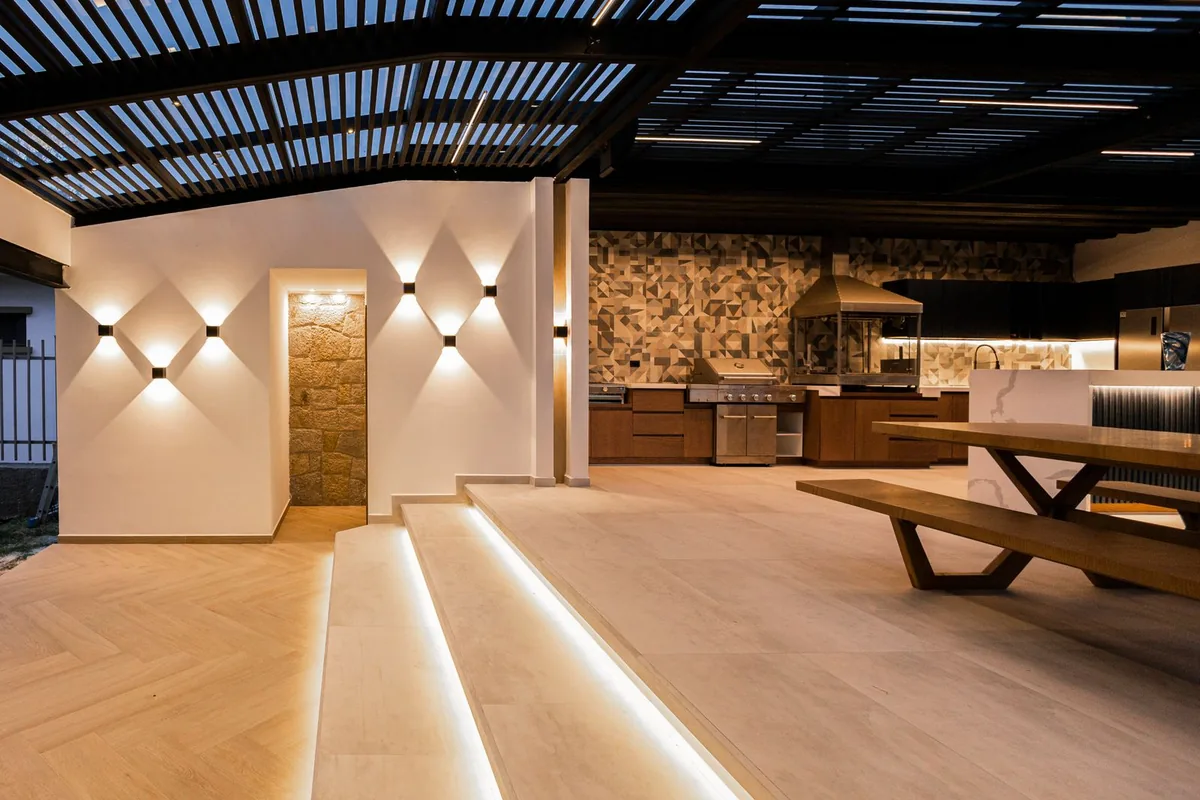
That last item is the one worth spending on first if the budget is finite. A covered run is shaded from UV, sheltered from direct rain and sees less salt deposition. It widens the material options, extends the life of everything beneath it, and makes the kitchen usable on far more days of the year. A roof over a modest run usually buys more than an uncovered expensive one.
What a Newport Beach terrace specifically asks for
Proximity to open water
The distinction that matters most is not indoors against outdoors but how close the run is to open water. A terrace on the Peninsula, on one of the eight harbour islands or on a bluff above the ocean is in a genuinely marine environment. A terrace in a sheltered inland part of the city, Newport Coast or Santa Ana Heights, is meaningfully less exposed. The survey records that distance, because it changes the specification.
Seasonal houses and long closures
48.3 percent of Newport Beach's vacant housing units are seasonal. An outdoor kitchen in a house that is shut for months is left uncovered, unused and unmaintained through the wettest part of the year. That argues strongly for the permanent material options over the maintainable ones, and for good covers as part of the specification rather than as an afterthought.
Salt deposition and the maintenance that actually matters
The single most effective maintenance on a coastal outdoor kitchen is rinsing it with fresh water, because salt deposits are what drive corrosion and they accumulate continuously. That is worth designing for: a hose point near the run, and a layout that can be rinsed down without water getting into the places it should not. It is a far more useful conversation than any discussion of coatings.
Next steps
For the corrosion and material question in depth, read the marine-grade cabinets guide. For a bar on the same terrace, the wine and bar cabinets page covers glass storage and service. For the permit sequence, see the permit and code guide. Coverage is on the service area page, and a quote starts at the contact page.