A sandspit that a flood built
The Balboa Peninsula is, in geological terms, a sandspit, and its present form is attributable to an 1825 flood which rerouted the Santa Ana River into West Newport. That flood caused sand to accumulate, and by 1857 the Peninsula had spread to half its present length. In 1920 the river was rerouted by the Bitter Point Dam to its present outlet west of the city line.
That is not a historical curiosity for a cabinet maker. It is the explanation for what the ground under these houses does. A sandspit is accumulated sediment rather than bedrock, and houses built on it settle, unevenly, over decades. In practice that means Peninsula floors are rarely flat, and a cabinet run set parallel to the floor will have a countertop that is not level and doors that do not line up.
The method is the same as anywhere and matters more here: find the highest point of the floor across the whole run, strike a dead level datum line from it, and shim every cabinet up to that line. The plinth then gets scribed to the real floor, which on a settled Peninsula house will visibly taper. The installation page covers the sequence in full.
The Peninsula also performs a structural job for the rest of the city: it acts as a jetty enclosing Newport Harbor and Newport Beach's eight islands. Everything behind it, the harbour, Balboa Island, Lido Isle, Linda Isle and the rest, exists because this sandspit is in the way of the ocean.
The wharf, the railway and the resort
The Peninsula was developed in three distinct waves, and you can still read which wave a house belongs to from the street.
The first was commercial. In 1888 the McFadden family, who had arrived in California around 1849, decided their shipping business would do better on the oceanfront than on the inner shores of the bay, where it could be connected by rail to Santa Ana. They built McFadden Wharf at the location where the Newport Pier stands today. In 1899 the federal government funded a new harbour at San Pedro, and the McFadden wharf and railroad were sold to the Southern Pacific that same year, ending Newport Bay as a commercial shipping centre.
The second wave was the resort. In 1902 James McFadden sold his Newport townsite and about half of the Peninsula to William Collins, who saw the bay's resort and recreation potential. Collins took on Henry E. Huntington as a partner in the Newport Beach Company; Huntington had acquired the Pacific Electric railway system and used it to promote new communities outside Los Angeles. In 1905 the Pacific Electric Balboa Line was extended to Newport, and Collins began dredging a channel on the north side of the bay, depositing the spoil on the tidelands that would become Balboa Island.
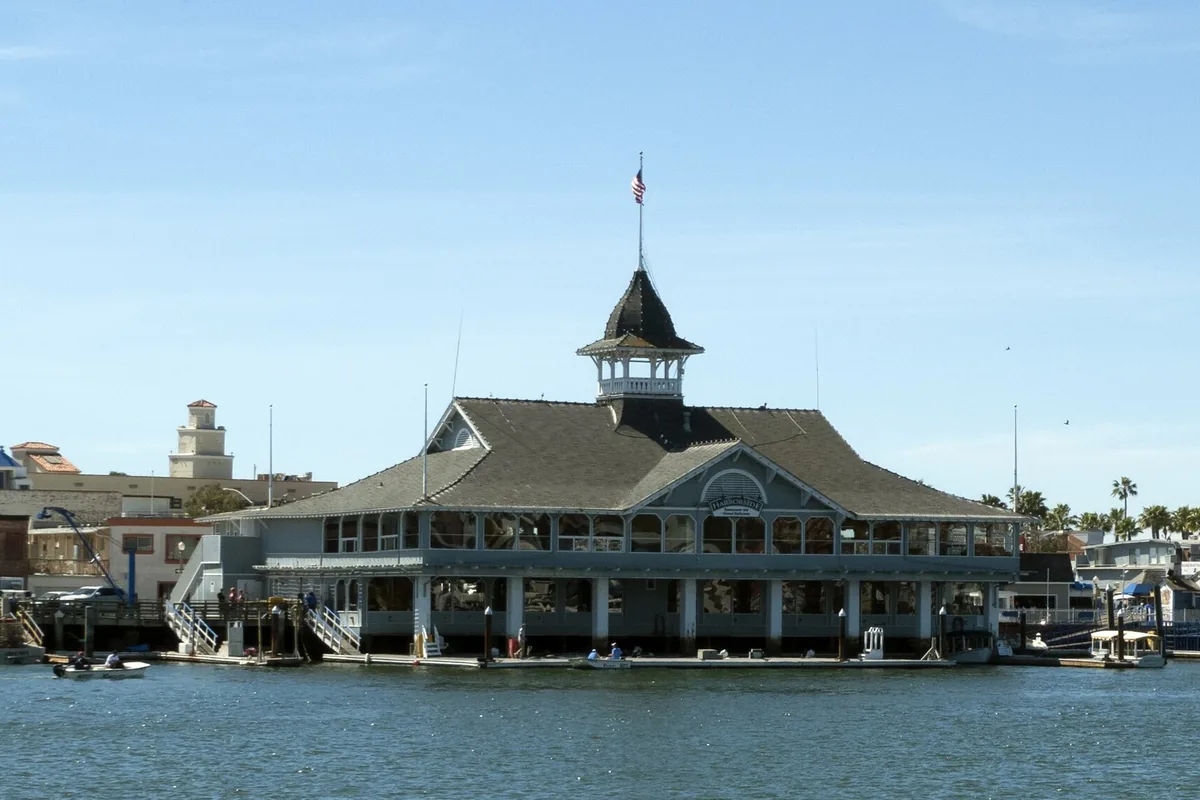
The third wave was the build-out, which continued through the first half of the century and has been rebuilding on the same footprints ever since. The landmarks date it precisely: Balboa Pavilion, established 1906; the Balboa Theater, 1928; the Balboa Inn, 1929. Alongside them sit the Balboa Fun Zone, the Dory Fishing Fleet and The Crab Cooker.
Balboa Boulevard, the bridges and the alley
The Peninsula is a long thin neighbourhood served by one main road and a network of alleys, and the alley is usually how cabinets arrive.
The published connection list is specific. The Peninsula connects to the land via Pacific Coast Highway at Balboa Boulevard and via the bridge at Newport Boulevard. From it, Via Lido connects by bridge to Lido Isle; there are bridges from Newport Island and Bay Isle; and the Balboa Island Ferry runs from Balboa Boulevard and Palm Street across to Balboa Island, which is itself connected by bridge from Jamboree Road.
The centre of the Peninsula is Balboa Village and the end of it is Balboa Peninsula Point. The Balboa Pier is near the ferry landing in Balboa Village, and about two miles toward Coast Highway is the Newport Pier at McFadden Square. A 2.9-mile boardwalk runs from 36th Street in West Newport past both piers to between E and F Streets.
- Which approach the delivery uses, and whether a long vehicle can make the turns at the Peninsula end
- Alley width behind the property, turning space, and whether a vehicle can stop in it legally
- Whether the practical route is through the garage, down a side passage or through the front of the house
- Gate widths, thresholds and the first interior turn
- Stair turns and headroom, which set the longest carcass that can reach an upper floor
- Parking for the crew, which on the Peninsula in summer is a genuine scheduling factor
From that, the carcass sizes are set. A tall unit specified in two stacked sections and an island built as four boxes rather than two cost nothing when decided at the survey and a great deal when discovered in an alley on the day.
Salt on two sides
The Peninsula is the most exposed residential ground in the city, because it has open ocean on one side and the harbour on the other with a few hundred feet between them.
The city-wide figure gives the scale: 29.13 of Newport Beach's 52.92 square miles is water, 55.04 percent, and Newport Harbor holds roughly 9,000 boats. On the Peninsula, neither body of water is far away from any house.
For cabinetry the consequence is metal rather than timber. The published benchmark is section 9.6 of the quality standard: a finished panel roughly 5 by 9 inches, scratched diagonally to bare metal with a razor blade, then exposed for 288 hours at 100 percent relative humidity and 37 to 39 degrees Celsius, permitting no blisters and no more than 0.0625 inch of rust creep.
The failure order is consistent and worth knowing before specifying: fasteners first, because a screw head carries a coating damaged by the driver; then slide runners, a large moving steel area; then hinge cups and plates; then handles, which are usually the best finished because they are the most visible. The marine-grade cabinets guide covers what to ask a supplier.
Small kitchens on narrow lots
Peninsula lots are narrow and deep, and a good proportion of the houses began as beach cottages, so the kitchens are compact and the clearance arithmetic is tight.
The published figures are 40 inches minimum of clear width between all opposing base cabinets, counter tops, appliances or walls in a pass-through kitchen, and 60 inches in a U-shape enclosed on three contiguous sides, measured from the furthest projecting face, excluding hardware. Those are not a mandate in a private kitchen; they are the only published numbers available and they correspond closely to what two people need to pass each other.
Run that arithmetic on a nine-foot Peninsula kitchen and an island takes a 28-inch footprint, which is shallower than a base cabinet. The honest answer in that room is a peninsula unit, a moveable table, or nothing. Saying so at the survey is better than drawing an island and letting the walkways take care of themselves.
The storage recovery is the same as anywhere, with more urgency: deep drawers rather than base cupboards, because the published unobstructed reach range of 15 to 48 inches excludes most of a base cupboard's volume; a tall unit rather than a wider run, because height is usually the only dimension available; and a genuine inventory conversation about what has to be stored.
What cabinets cost on the Peninsula
The same published bands apply: $500 to $1,500 per linear foot installed, which puts a 15-foot kitchen at $7,500 to $22,500 and a 25-foot kitchen at $12,500 to $37,500. Peninsula kitchens are frequently at the smaller end of that, so the totals are often lower than the city-wide examples.
What rises is install time. Alley access, a carry from wherever the vehicle can stop, summer parking pressure, and a settled sandspit floor that needs more shimming all add hours. An honest quote prices the cabinetry on its merits and the access separately, rather than marking up materials for a beach address.
The published Newport Beach modelled figures apply at the city level rather than by neighbourhood: installation $1,443 to $13,236, refacing $1,561 to $2,457 for twelve cabinets in laminate, refinishing $995 to $5,537 and painting $981 to $5,459. The full picture is in the cost guide.
Next steps
For the island across the channel, see Balboa Island. For the western end of the sandspit, see West Newport, and for the island reached by Via Lido, see Lido Isle. For a compact kitchen, start with kitchen cabinets. Full coverage is on the service area page, and a quote starts at the contact page.